
In food businesses, most safety controls focus on the kitchen.
But what happens after the food leaves the kitchen?
If hot food cools down during delivery…
If seals are not tamper-proof…
If delivery bags are dirty…
If riders are unhygienic…
Then all the hard work inside the kitchen is wasted.
Food safety does not end at cooking.
It continues until the food reaches the customer.
That is why a Food Dispatch & Delivery Hygiene Audit Checklist is critical for cloud kitchens, QSRs, food delivery brands, and central kitchens.
In this blog, you will understand how this checklist works, what risks it prevents, and how it helps food businesses maintain hygiene, compliance, and customer trust even during delivery.
What Usually Goes Wrong After Food Leaves the Kitchen?
Ready-to-eat food is highly sensitive.
Once food is prepared, even small mistakes during dispatch or delivery can cause serious problems.
Common issues include:
Bacterial growth due to temperature drops
Customer complaints about cold or spoiled food
Leakage or damaged packaging
Online negative reviews
Regulatory action during food safety inspections
Loss of repeat customers
Many kitchens maintain strong HACCP and food safety controls, but the dispatch and last-mile delivery process is often ignored.
This checklist ensures food safety continues beyond the production line.
How This Checklist Covers the Entire Dispatch and Delivery Process
This is not just a packaging checklist.
It monitors the entire last-mile food handling process, from dispatch counter to customer delivery.
It checks:
Food holding time
Temperature compliance
Packaging safety
Rider hygiene
Delivery bag cleanliness
Dispatch verification
Delivery timelines
Documentation and records
Instead of random checks, the checklist is organized into clear operational sections.
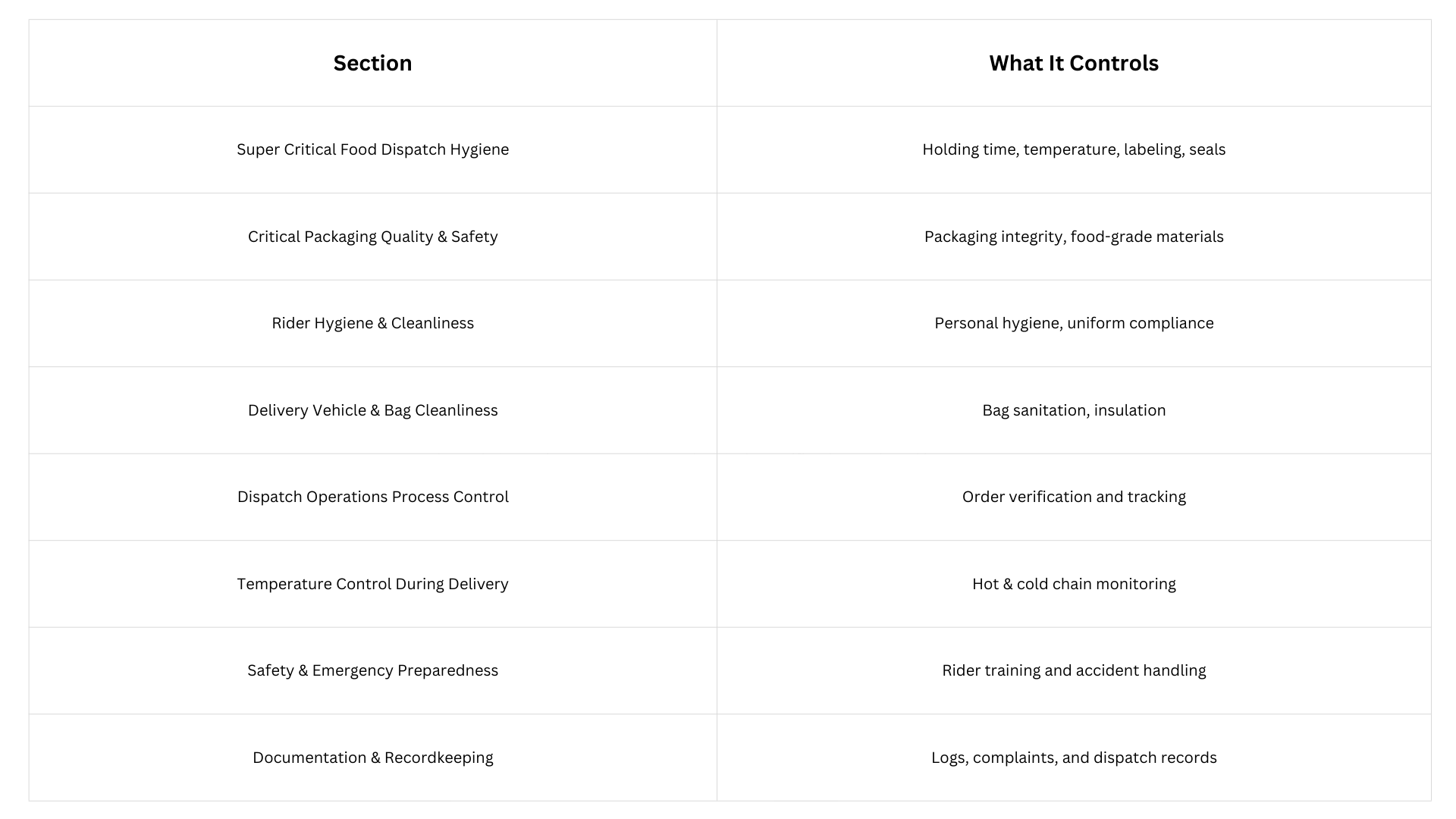
Each section controls a different risk area in the food delivery process.
Downloads Available
To help teams use this checklist easily during inspections and audits, the Food Dispatch & Delivery Hygiene Audit Checklist is also available for download.
You can download the checklist in the following formats:
PDF – for quick reference during audits and training
Word – for customization and internal documentation
Excel – for scoring, tracking, and performance monitoring
These downloadable formats allow teams to adapt the checklist based on their operational needs while maintaining consistent food safety and dispatch hygiene standards.
How These Checklist Features Help You Control Delivery Risks
This checklist is not just about asking “Yes or No”.
It includes structured attributes that help teams verify, record, and track delivery hygiene properly.
These include:
Scoring options (compliant / partial / non-compliant)
Order verification checks
Label and seal verification
Temperature standards
Random inspection points
These features turn a normal dispatch check into a food safety control system. Instead of guessing whether dispatch operations are working properly, teams can measure compliance clearly.
How Scoring Shows Where Dispatch Problems Are Growing
Many questions in this checklist use a simple scoring system.
For example:
Within time limit / Slight delay / Exceeded time
Clean & organized / Minor issues / Unclean
Fully compliant / Partially compliant / Non-compliant
This scoring helps management quickly see:
If dispatch temperature control is failing
If packaging quality is declining
If rider hygiene compliance is dropping
Low scores immediately highlight risk areas that need corrective action. Instead of reacting to complaints, teams can detect problems early.
Why Labels, Order IDs, and Verification Checks Matter More Than You Think
Some questions in this checklist verify details like:
Order ID labeling
Allergen information
Dispatch time stamps
POS order verification
Supervisor checks before dispatch
These details ensure that the right food reaches the right customer safely.
For example:
If orders are not verified against POS → wrong deliveries happen.
If allergen labels are missing → customer health risks increase.
If time stamps are missing → delivery delays cannot be tracked.
These verification steps improve traceability and accountability.
How Image Capture and Proof-Based Checks Improve Dispatch Monitoring
In many digital checklists, certain questions allow image capture or visual proof.
For example:
Photo of sealed packaging
Image of dispatch area cleanliness
Photo of insulated delivery bag
Image of labeled orders
These images help supervisors verify:
Whether packaging seals are properly used
Whether the dispatch area is hygienic
Whether delivery bags are clean and insulated
Images act as evidence of compliance, reducing disputes and improving transparency.
They also help managers review multiple kitchens remotely.
Who Usually Executes This Checklist in Real Operations?
This checklist is not only for external food safety audits.
It is typically executed by:
Dispatch supervisors
Quality assurance teams
Operations managers
Food safety officers
These teams verify that delivery hygiene standards are followed consistently.
When responsibilities are clearly defined, accountability improves.
What Starts to Break Down When Dispatch Hygiene Is Ignored?
If dispatch controls are weak, multiple risks appear quickly.
For example:
If food stays too long at dispatch → temperature drops.
If packaging seals are weak → tampering complaints increase.
If riders lack hygiene → brand reputation suffers.
If delivery bags are dirty → contamination risk increases.
These problems lead to:
Customer dissatisfaction
Negative online reviews
Food safety violations
Regulatory penalties
In the food delivery business, one viral complaint can damage brand trust quickly.
Why Paper-Based Dispatch Monitoring Often Fails
Many kitchens still use paper logs for dispatch checks.
But paper systems create problems:
Dispatch records get lost
Temperature checks are not verified
No photo proof is available
Trend tracking becomes difficult
Missed checks go unnoticed
Paper systems also slow down investigation when complaints occur.
How Running This Checklist Digitally Improves Control
Digital execution makes dispatch monitoring much more reliable.
Digital systems allow:
Real-time dispatch inspections
Photo capture of packaging and seals
Geo-tagged inspection records
Automatic alerts for missed checks
Rider compliance tracking
Analytics dashboards for delivery performance
Digital monitoring provides visibility across multiple kitchens or outlets.
How This Checklist Builds Discipline in Delivery Operations
A dispatch hygiene checklist is not just a compliance requirement.
It helps food businesses:
Standardize delivery operations
Train new riders quickly
Improve packaging discipline
Monitor temperature control
Maintain audit readiness
Over time, teams stop seeing the checklist as extra work.
Instead, it becomes a daily protection system for food safety and brand reputation.
A strong Food Dispatch & Delivery Hygiene Audit Checklist ensures that food safety continues until the meal safely reaches the customer.
In today’s delivery-driven food industry, last-mile hygiene control is just as important as kitchen hygiene.


