
Why inspections matter
Inspections matter because they create evidence.
They show what is actually happening on the ground, not what people assume is happening. This visibility is critical for operational risk management and long-term compliance.
A well-structured inspection management system gives management real data points they can act on. Without inspections, most issues remain invisible until they become serious risks.
Teams often believe operations are under control, but without documented quality inspections, there is no proof. Decisions then get made based on gut feel, partial information, or delayed reports. Regular inspections bring facts into the system in a consistent and measurable way.
Businesses conduct inspections to meet regulations, ensure compliance, and maintain operational discipline. Over time, inspections also help maintain consistency across locations, especially as organizations scale.
Both small and large businesses perform inspections.
However, inspections become far more critical for medium and large organizations, particularly those operating across multiple cities, states, or countries.
What counts as a “large” organization in food businesses
In food businesses, a large organization usually means operations where scale increases complexity and variation in risk.
For example:
A restaurant chain with 200+ outlets
A food manufacturing business with multiple production facilities
A consumer goods company operating across cities or states
In such environments, not all business units operate the same way. Inspection frequency, risk exposure, staff capability, and operational maturity vary significantly across locations.
This is why applying the same audit frequency everywhere often leads to inefficiencies.
How inspection frequency is usually decided
While working with organizations implementing digital inspections, one common pattern appears repeatedly.
Inspection frequency is usually fixed by calendar.
For example:
Monthly inspections
Quarterly inspections
One or two audits per facility per year
Even when additional inspections are added, they are usually reactive — triggered only after a major incident, complaint, or audit failure.
Otherwise, every site follows the same inspection schedule, regardless of risk profile or past performance. This approach limits the effectiveness of any inspection strategy.
Why fixed inspection frequency does not work
A single inspection schedule does not work for all business units.
Different locations vary across multiple dimensions:
Frequency of issues reported during inspections
Operational incidents logged outside inspections
Age of the business unit — newer units usually require more oversight
Customer complaints, feedback, or online reviews
Treating all locations equally leads to several problems:
High-risk locations do not receive enough attention
Stable locations are inspected more than necessary
Inspection resources are not used effectively
This weakens overall inspection effectiveness and limits the value of inspection data.
Using data to decide inspection frequency
Instead of fixing inspection frequency by calendar, organizations can determine it using risk-based inspections.
Inspection scheduling can be driven by data rather than assumption.
Inputs used to decide inspection frequency
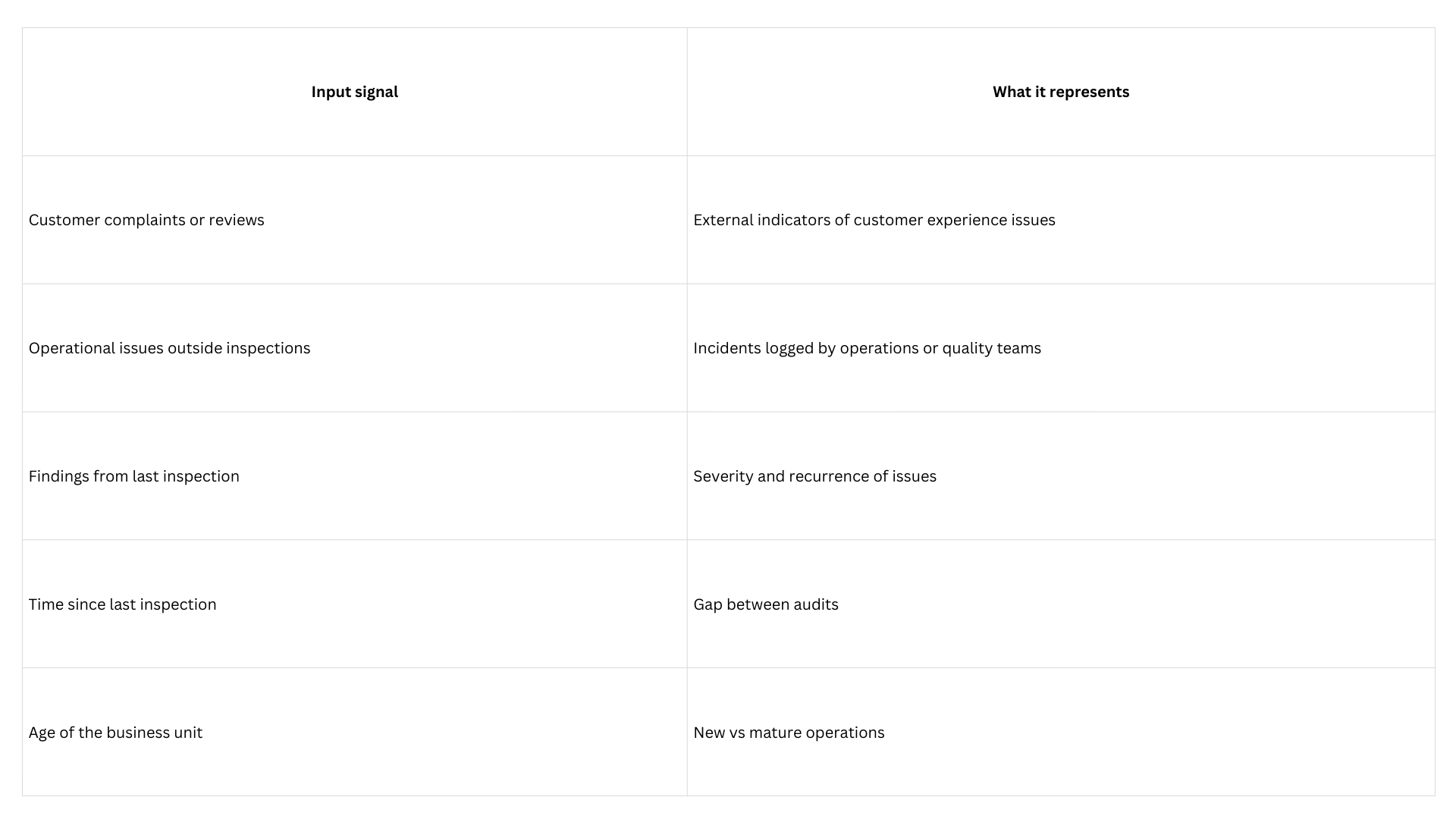
No single data point is enough on its own.
The real value comes from combining these signals through inspection data analysis.
This approach allows inspection frequency to reflect actual risk instead of fixed timelines.
How AI helps in inspection management
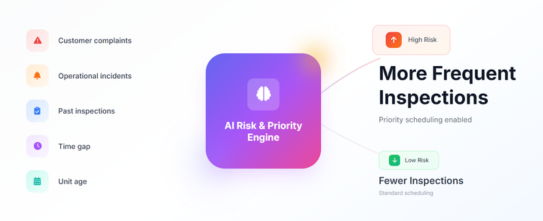
This is where AI in inspections plays a practical role.
AI can evaluate multiple data inputs simultaneously and recommend inspection frequency based on real risk patterns. This supports smarter inspection scheduling without increasing manual effort.
The purpose of inspections does not change.
What changes is how inspection capacity is allocated.
AI does not replace human judgment.
Instead, it automates decisions that quality and operations teams already agree with — but struggle to implement consistently due to limited bandwidth.
For AI-driven inspection management to work effectively, organizations must track reliable operational data. AI cannot compensate for missing information.
A real example from a large restaurant chain
One of our clients operates more than 500 restaurant outlets nationwide.
Earlier, they followed a uniform inspection model — one inspection per site every month. This fixed inspection frequency was applied even though performance varied significantly across locations.
Some outlets showed recurring quality issues and frequent customer complaints. Others were stable and well-managed. Yet all were inspected at the same frequency.
By shifting to a risk-based inspection frequency model, inspection schedules were adjusted based on performance, maturity, and historical data.
Locations requiring closer monitoring were inspected more often, while stable locations were inspected less frequently.
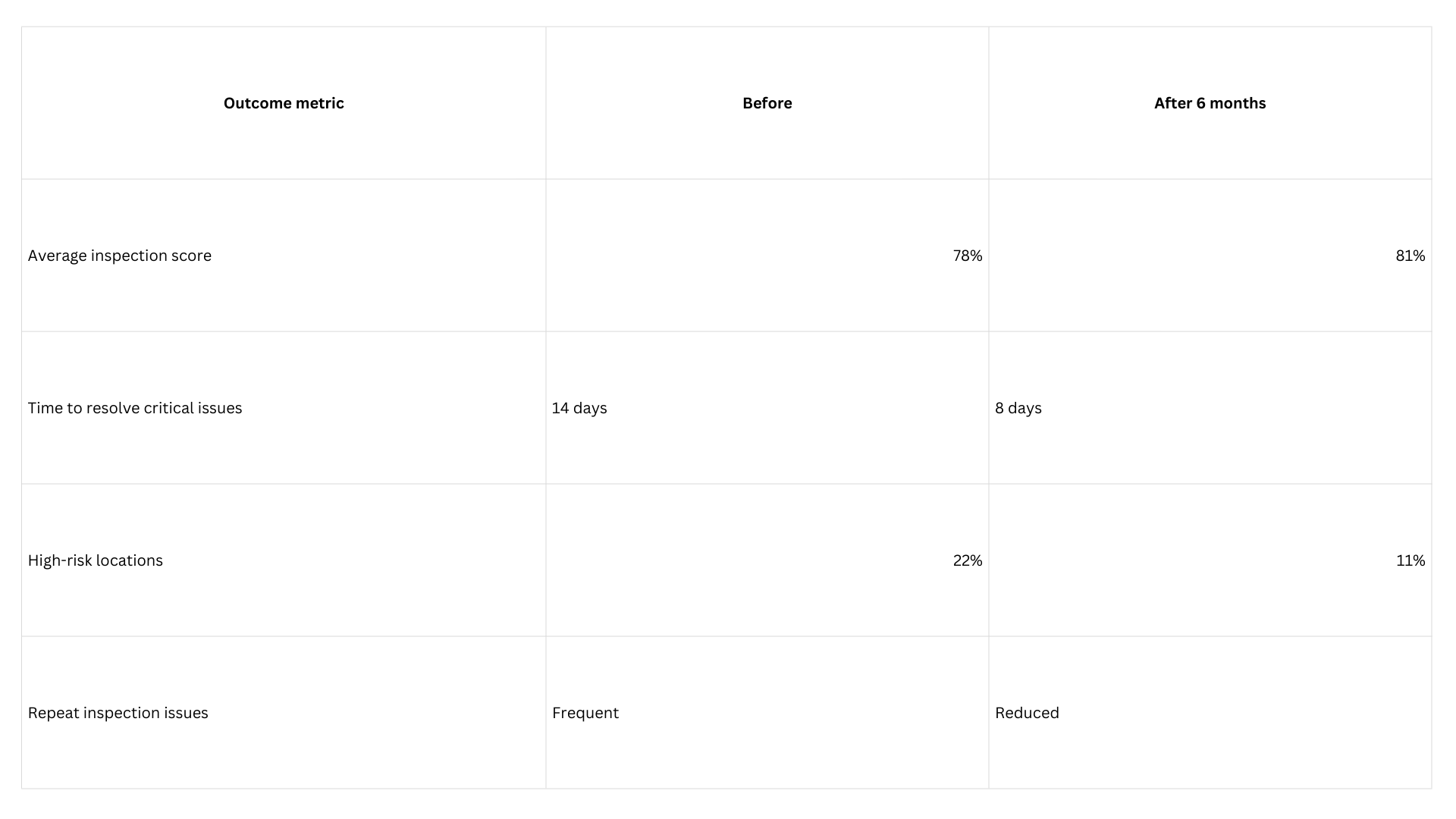
Results after six months
This demonstrated how data-driven inspection planning improves both compliance and operational efficiency.
Why this approach is rarely done manually
Although the logic is clear, most organizations struggle to implement it manually.
Teams often lack the bandwidth to:
Combine multiple inspection and operational data sources
Continuously recalculate inspection schedules
Justify audit frequency changes across locations
As a result, fixed inspection schedules continue even when they are clearly suboptimal.
What this means for organizations
Inspection frequency should never be static.
It should reflect risk level, operational maturity, and real performance data.
With modern inspection management systems and AI-driven analysis, organizations can implement risk-based inspections consistently and at scale.
This shift does not increase headcount or inspection load — it simply improves how inspection resources are allocated.
For organizations operating at scale, optimizing inspection frequency alone can significantly improve compliance, reduce repeat issues, and strengthen overall operational control.


