
Inspections Are Important. Period
Inspections exist to prevent major business risks in any industry where there is an intersection of manpower, machinery, raw materials, and sometimes customers.
In such environments, operational risk management becomes critical.
The possibility of untoward incidents is never far away.
There could be an injury to workers in a food production facility, at a construction site, inside a warehouse, or in a mining operation. These are precisely the environments where safety inspections and quality inspections play a critical role.
If a business also caters directly to consumers, the risk multiplies further.
A food safety inspection failure.
An expired product shipped by mistake.
A contamination incident leading to a product recall.
Now consider another scenario — a hotel where fire extinguishers are not functional and a fire breaks out. At that point, the risk is no longer internal. Customers and guests are directly exposed.
This is exactly why quality assurance inspections and safety compliance inspections exist.
To prevent business shutdowns.
To prevent regulatory action.
To prevent lawsuits.
To prevent irreversible brand damage.
Inspections Are Obvious. Effective Inspections Are Not
In theory, any organization operating at scale should have a structured inspection program.
In practice, many inspection programs exist only on paper or in intent.
Despite having defined checklists and processes, the actual inspection effectiveness remains low.
There are several risks that prevent inspection programs from delivering value.
These include:
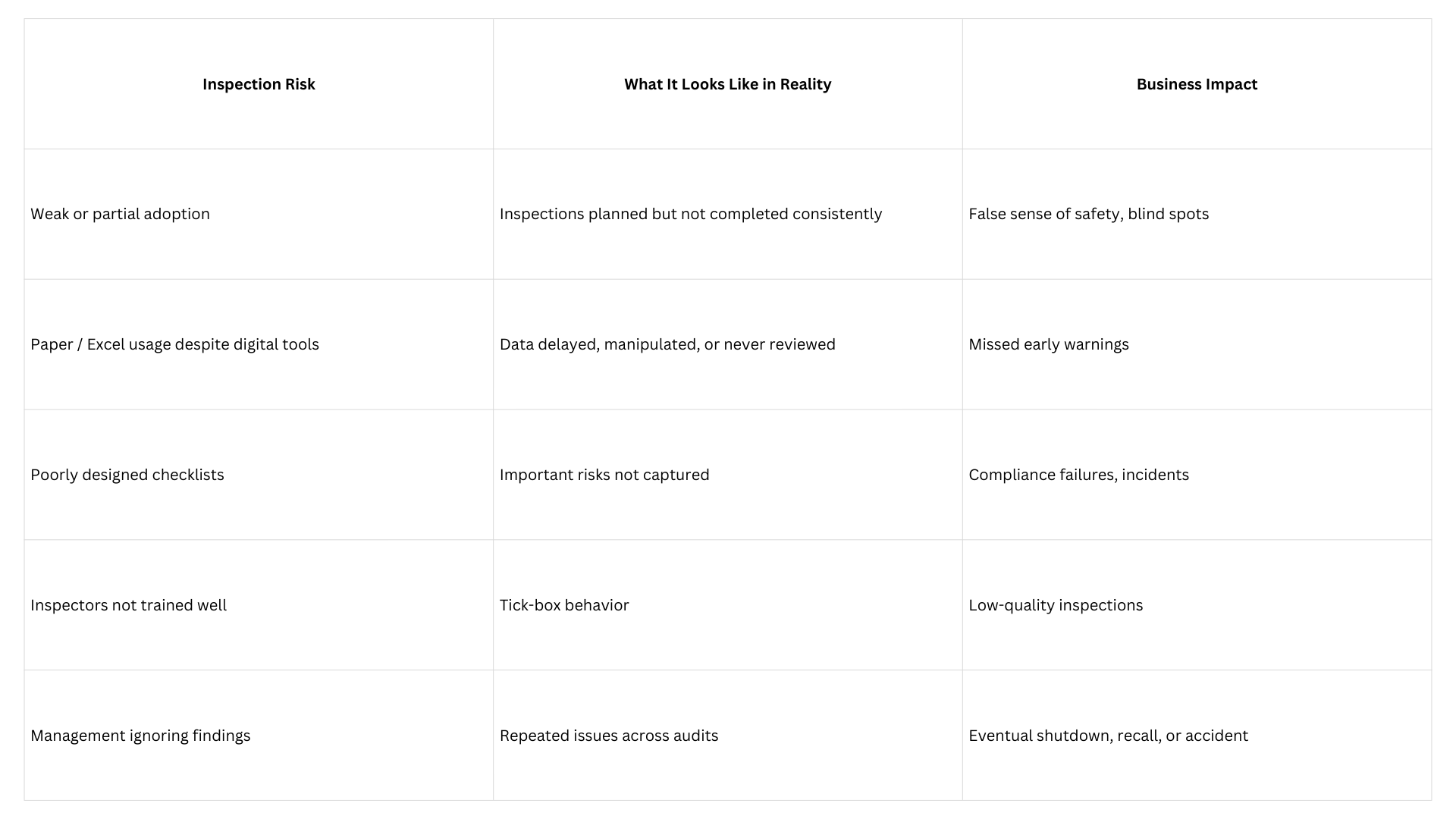
Inspection checks that are not thorough or not aligned with compliance requirements
Lack of training for inspectors or quality personnel
Management not acting seriously on inspection findings
Absence of a proper digital inspection management system
Weak or partial inspection adoption across teams
Without strong adoption, even the best-designed inspection framework fails.
Adoption Risk: The Most Dangerous One
Adoption risk is one of the most dangerous — and most deceptive — risks in any inspection program.
It is deceptive because organizations often believe their inspection management system is working, while silent gaps continue on the ground.
The real danger is this:
You do not need dozens of incidents to damage a business.
One or two major failures are enough. History has proven this repeatedly across industries.
This is why inspection adoption matters as much as inspection design.
One Method That Actually Works at Scale
There is one proven method that consistently improves inspection program adoption, especially in large organizations.
This approach works particularly well where:
Organizational culture is formal
Operations are spread across multiple geographies
Processes are documented and consequences are clearly defined
The method is simple in concept.
Link the KPIs of everyone involved in the inspection process to inspection adoption — and in some cases, also to performance.
Performance linkage depends on the business model.
Adoption, however, is non-negotiable.
Why Linking Only Performance Is Not Enough
Performance is an outcome.
It appears only after an inspection is completed.
But many organizations struggle at a much more basic level — ensuring inspections are actually conducted, and conducted on the approved digital inspection tool.
Organizations invest in inspection software, yet teams continue to rely on paper checklists, Excel files, or parallel systems.
At this stage, the issue is not inspection quality.
The issue is digital inspection adoption.
Without clear accountability, inspection programs fail to scale.
This is why many organizations introduce monetary or appraisal-linked disincentives when adoption benchmarks are not met.
The message becomes clear:
The inspection program is not optional.
Why Teams Resist Adoption (Even When It Makes Sense)
Before explaining why KPI linkage works, it’s important to understand why adoption resistance occurs.
At its core, this is change management.
People resist transparency.
People resist accountability.
Even limited resistance is enough to break inspection discipline.
Other common reasons include:
The inspection tool is not easy to use
The inspection process feels cumbersome
There are no visible consequences for non-adoption
This is why ease of use is critical in any inspection management platform.
For example, Pulse inspection solutions are designed for frontline teams. In large operations, usability is not a nice-to-have — it is a requirement for sustained adoption.
“Isn’t It Unfair to Link Money to Inspections?”
This question is common.
The answer is straightforward.
Organizations implement inspection programs to protect themselves from serious operational, legal, and reputational risk.
Without reliable inspections, businesses cannot scale safely or operate with confidence.
Some teams may believe inspections are optional.
Organizations cannot afford that assumption.
A single incident can undo years of brand trust.
Why This Method Works
This approach works for three clear reasons:
1. Employees are only responsible for their defined roles
Inspectors, reviewers, and closure owners are not being assigned extra work. These responsibilities already exist within the quality and compliance function.
2. Digital inspection tools create visibility
A digitized system makes adoption measurable. It becomes clear who is compliant, who is consistent, and where gaps exist.
Adoption can be recognized.
Non-adoption can no longer remain hidden.
In simple terms, organizations communicate clearly:
“This is part of your job. These are the expectations. And these are the consequences.”
A Real Example from the Field
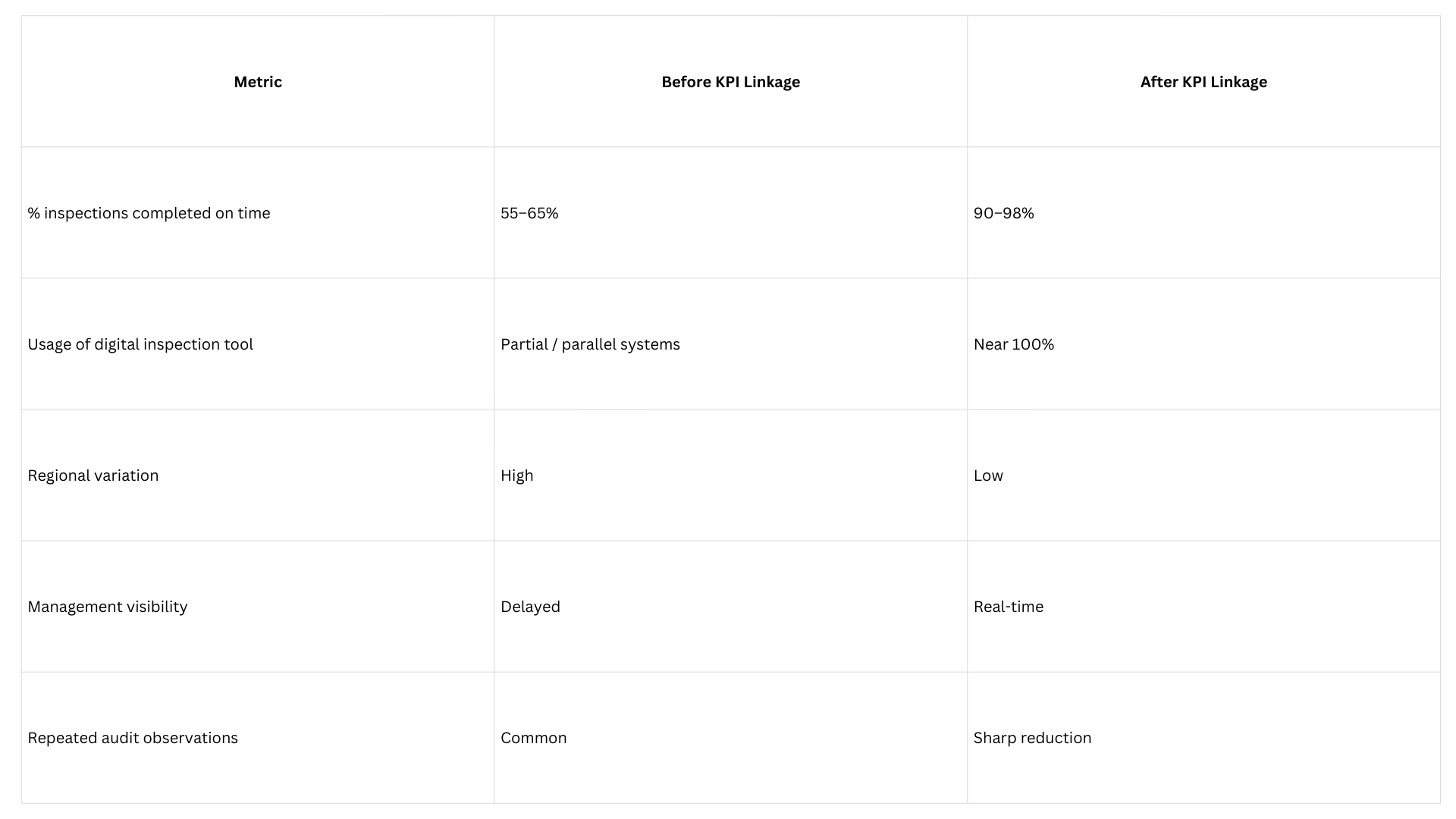
A large food production company operating multiple manufacturing plants across continents faced low inspection adoption during its pilot phase.
Two out of five regions showed weak compliance with the digital inspection program.
The Head of QA explained that once the system was fully onboarded, an official circular would be issued.
The circular would mandate completion of defined inspections through the tool.
Non-compliance would be treated as insubordination, as per company policy.
Inspection adoption would also be linked to appraisal metrics.
Once the circular was issued, adoption normalized rapidly.
In organizations with formal culture, clarity and documentation drive behavior.
Why Gradual Adoption Often Fails
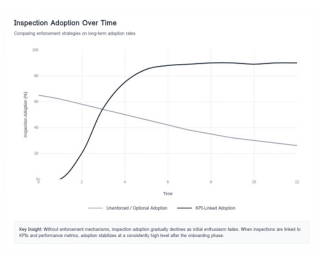
Many organizations assume inspection adoption will improve gradually.
In reality, teams observe each other.
They follow the lowest common denominator.
If one unit treats inspections casually, others soon follow.
This is why organizations must establish seriousness from day one — or after a clearly defined acclimatization period.
After that, expectations must be uniform.
Anything else slowly erodes inspection discipline.
Closing Thought
Inspections do not fail because organizations do not care about quality.
They fail because inspection adoption is treated as optional.
Linking inspection adoption to KPIs is not about punishment.
It is about clarity.
And clarity is what keeps businesses safe, compliant, scalable — and alive.


